


Blog


The population of occupied Crimea is declining. Why do the occupiers claim there is demographic growth?
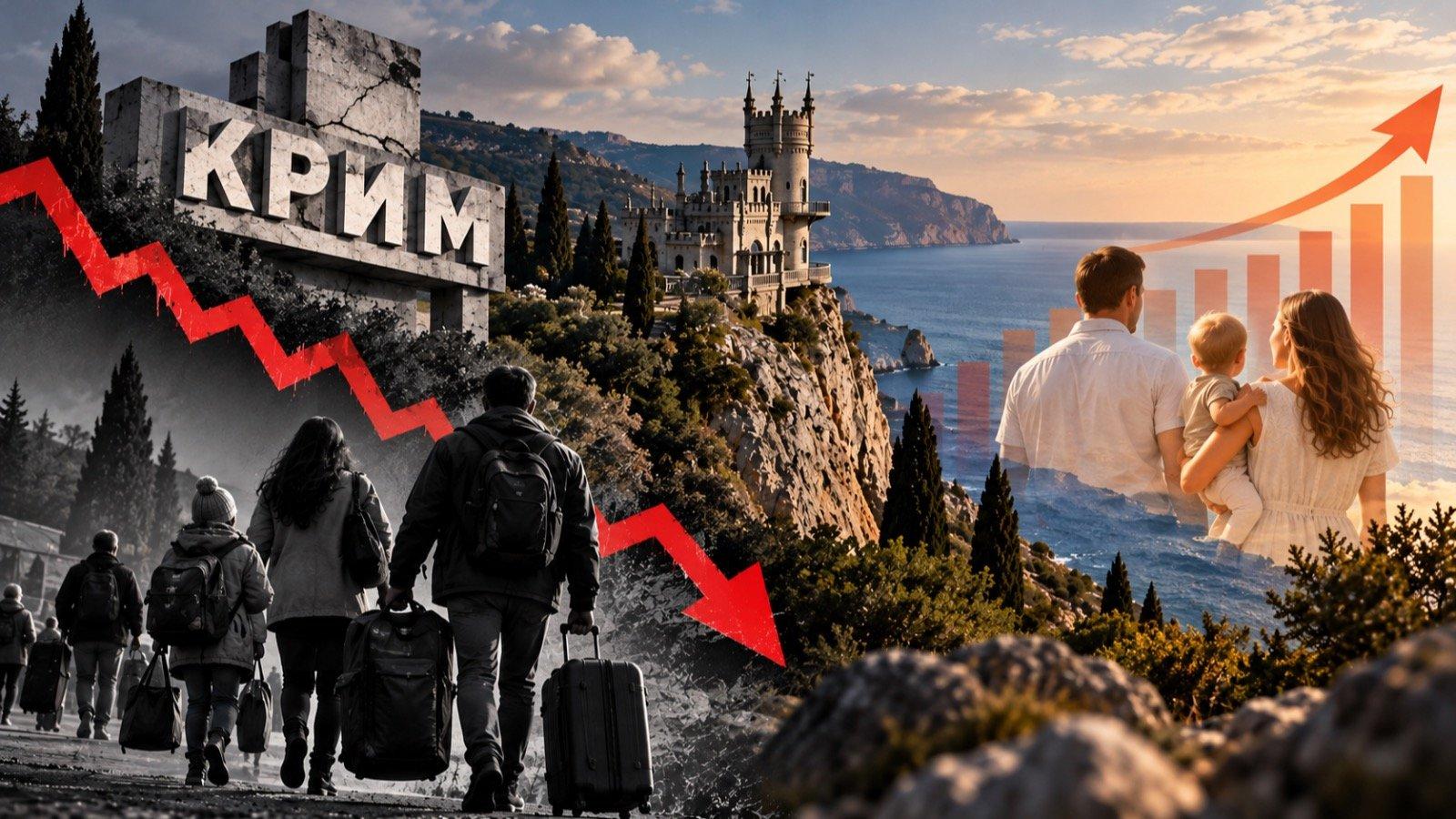
In March 2026, the so-called speaker of the Crimean parliament, Vladimir Konstantinov, stated that the population of occupied Crimea was no longer declining. At the same time, in that same statement, he acknowledged that more people are dying on the peninsula than are being born. The contradiction was explained simply: according to him, the natural decline is offset by migration — every year, between 5,000 and 7,000 families move to Crimea.
At first glance, the math does indeed add up. Some residents are leaving, others are arriving to take their place, and the total population remains unchanged or even grows.
The population is not being replenished
The problem of natural population decline existed on the peninsula even before 2014. As in many other regions of Ukraine, the population was aging and the birth rate was gradually declining. The Russian occupation did not halt these processes. On the contrary, after 2014, large-scale migration changes compounded the natural population decline. Some Crimeans were forced to leave their homes due to political persecution, pressure, forced passport issuance, the persecution of pro-Ukrainian activists, and the inability to continue their normal lives under occupation.
At the same time, Russia began actively settling the peninsula with its own citizens. Initially, these were Russian military personnel, law enforcement officers, government officials, and their family members. They were later joined by public sector employees, construction workers, entrepreneurs, and other Russian citizens. Consequently, since 2014, Crimea’s population has become increasingly less dependent on the number of births and deaths on the peninsula. Another factor is beginning to play a key role: how many people Russia is relocating to the occupied territory.
Sevastopol as the Most Striking Example
This is particularly noticeable in Sevastopol. At the beginning of 2014, the city had a population of about 386,000. According to occupation statistics, by early 2025, the population had already exceeded 558,000. In other words, over the course of eleven years, the population has formally grown by approximately 45%. At first glance, this may appear to be a demographic success.
But there is one problem: the number of deaths in Sevastopol consistently exceeds the number of births. In other words, the city could not have grown by more than 170,000 people through natural population growth. The main source of population growth has been colonization — the relocation of Russians from Russia to occupied Crimea. Therefore, the figure of 558,000 speaks not so much to Sevastopol’s demographic growth as to the scale of the change in the composition of its population.
And these are fundamentally different things.
Fewer Children
There is another indicator that allows us to assess the demographic situation: the number of children. More specifically, the number of children entering first grade. In August 2026, the occupation administration released data regarding the new school year. According to these figures, 19,938 children were expected to enter first grade in occupied Crimea in 2026. By comparison, there were 25,400 first-graders in 2022, 24,568 in 2023, and 22,711 in 2024. In 2025, this figure stood at about 20,000. In other words, in just a few years, the number of first-graders has dropped by more than 5,000. The situation in Sevastopol is even more telling. While there were 6,220 first-graders there in 2022, the forecast for 2026 was only 2,390 children.
Of course, the number of first-graders cannot be mechanically equated with the number of births. This figure is influenced by migration, the outflow of families, the age structure of the population, and other factors. But that is precisely why these statistics are important. They show more than just a change in the birth rate. They show that the younger age groups on the peninsula are shrinking.
If this trend continues, in a few years it will affect more than just schools. Smaller generations of children will mean fewer students, fewer young workers, and fewer future parents. In other words, today’s decline in the number of first-graders may be one of the early signs of a much deeper demographic problem.
So where, then, does this “demographic growth” come from?
The answer is quite simple. The occupying authorities are effectively conflating two different indicators: natural population change and the total population. The natural balance remains negative: more people are dying than are being born. At the same time, the total population may not be decreasing because the losses are offset by migration from Russia. Therefore, statements about the stabilization of Crimea’s population should not be equated with an improvement in the demographic situation.
This does not mean that the demographic situation has significantly improved. It does not mean that more children are being born. Nor does it mean that the peninsula’s population has begun to reproduce naturally.
First and foremost, this is about population replacement. Some people leave or naturally drop out of the demographic structure. Others arrive to take their place. And if you look only at the total population figure, it’s easy to overlook this change. Therefore, when the occupying authorities claim that Crimea’s population “is no longer declining,” it’s always worth asking a second question: what is preventing it from declining?
And the answer to that question speaks volumes — Russian colonization.
This article was prepared with the support of the
Polish-German Cooperation Foundation
 1355 views
The published material is copyrighted. The opinions expressed in the author's blog may not coincide with the position of the editors of the «Voice of Crimea» IA.


