


Blog


Who Will Live in Crimea Tomorrow? The Demographic Consequences of Twelve Years of Occupation
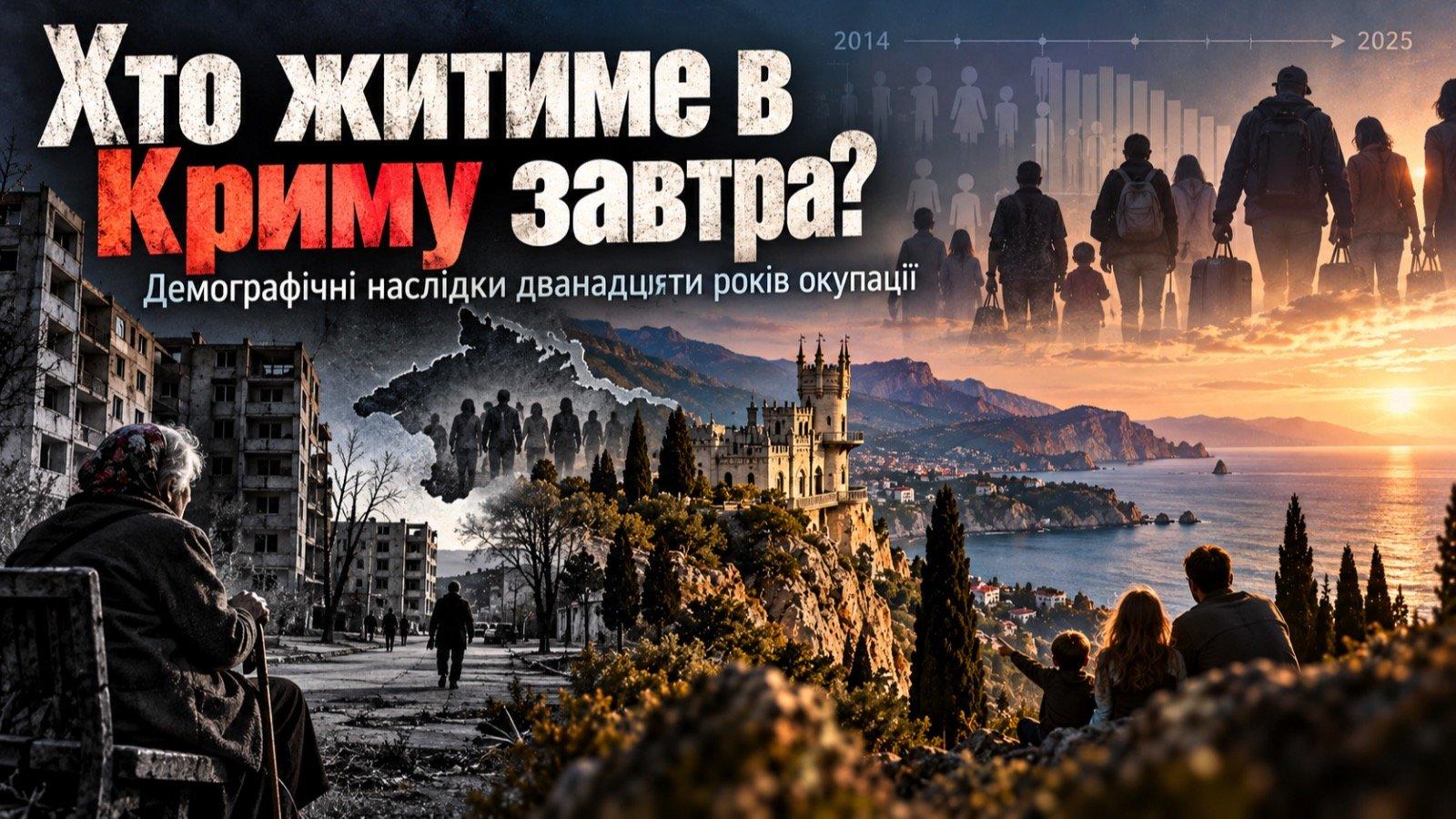
When we talk about the demographics of the temporarily occupied Crimea, the discussion usually quickly boils down to numbers. How many people left the peninsula after 2014? How many Russian citizens have moved to Crimea during this time? How many people actually live there today?
There are no exact answers to these questions. Russian statistics as of early 2025 showed approximately 2.46 million permanent residents in the Autonomous Republic of Crimea and Sevastopol. However, according to estimates by experts at the Black Sea Strategic Studies Institute, in June 2026 there could have been about 3–3.1 million people permanently residing on the peninsula, not including tourists. Of these, approximately 1–1.1 million are Russian citizens who settled in Crimea after the occupation began. These are estimates, not the results of an independent census. But even they reveal the scale of the changes that have taken place over the past twelve years.
But today, another question is becoming more important: not how many people live in Crimea now, but who will live there in five or ten years. Twelve years is enough time for processes that initially seemed temporary to become entrenched. People are buying homes, starting families, having children, and building careers. Children born after the occupation are growing up. And along with this, not only is the peninsula’s population changing, but so is its demographic structure.
If the occupation continues
The simplest scenario to predict is a continuation of the current situation. If nothing fundamentally changes, Crimea’s population will continue to be shaped by two opposing processes. On the one hand, there is natural population decline and aging. On the other—migration, primarily from Russia. Therefore, the total number of residents on the peninsula may even remain relatively stable. But a stable number does not mean a stable population.
This is particularly evident in the case of Sevastopol. While approximately 386,000 people lived there in early 2014, occupation statistics already showed over 558,000 by early 2025. Such growth could not have been the result of natural population growth, since the number of deaths consistently exceeded the number of births. Migration was the main factor behind the population increase. And here, it is not just the sheer number of new residents that matters.
In 2014, a person who had just moved from Russia to Crimea was a newcomer. Twelve years later, some of these people already have homes, jobs, businesses, families, and children here. In another five or ten years, their ties to the peninsula will be significantly deeper. That is precisely why the demographic consequences of the occupation are becoming more complex with each passing year. It is no longer enough for Russia to simply relocate its own citizens to the peninsula. Over the years of occupation, an environment is taking shape in which these demographic changes are beginning to take root on their own—through families, the birth of children, property ownership, and social ties.
And at the same time, a generation is growing up that simply has no memory of a different Crimea.
A generation that grew up under occupation
Children born in the first year of the occupation will be eleven or twelve years old by 2026. In four years, they will be teenagers aged 15–16. And those who started first grade after the occupation began will become adults by 2030. For them, the Ukrainian Crimea of before 2014 is not a personal experience, but rather stories told by their parents and older relatives.
They have spent their entire conscious lives in a system where Ukrainian state institutions are absent, the Ukrainian language has been pushed out of school education, and the curricula, youth policies, and an increasingly militarized upbringing are aimed at shaping a Russian identity.
And this, in my opinion, is one of the biggest long-term problems.
In a few years, Ukraine will be dealing with more than just the consequences of Russian resettlement. There will be a large group of young people on the peninsula for whom Russian schools, Russian documents, Russian universities, and Russian state institutions were the only everyday reality they knew. This does not mean that all of them will automatically have a Russian identity or support the occupation. It would be a mistake to generalize in this way. But one thing is clear: the longer the occupation lasts, the more people will come of age without any personal experience of life in the Ukrainian state.
Consequently, after de-occupation, the issue of Crimea’s return will not end with the raising of the Ukrainian flag. It will involve a lengthy process of restoring Ukrainian institutions, education, the information landscape, and people’s ties to the state.
What if Crimea ceases to be attractive to Russian colonizers?
However, the current demographic trend will not necessarily continue indefinitely.
Russian migration to Crimea depends not only on the Russian Federation’s state policy. People move to places where they see safety, jobs, housing, and prospects for themselves. If these advantages disappear, the direction of migration changes as well.
Therefore, another scenario is possible: Crimea is gradually becoming less attractive to those Russians who moved there after 2014.
Increasing military risks, transportation problems, a deteriorating economic situation, and a growing perception of Crimea not as a safe resort but as a war zone could significantly influence migration decisions. Ukraine has already struck the Kerch Bridge on multiple occasions. In 2026, Ukrainian forces also intensified strikes against the military and logistical infrastructure of the occupied peninsula and supply routes through the occupied parts of the Kherson and Zaporizhzhia regions. At the same time, the peninsula is facing problems with fuel, electricity, and economic activity.
If these trends intensify, some of the people who moved to Crimea after 2014 and do not have deep family or other ties to the region may decide to leave. This is no longer a fantasy but one of the possible scenarios for the future.
But such a scenario would not mean an automatic return of the demographic situation to its 2014 state. Twelve years have already changed the peninsula. And even a large-scale exodus of Russian settlers would not completely reverse this.
This article was prepared with the support of
the Polish-German Cooperation
Foundation
 1124 views
The published material is copyrighted. The opinions expressed in the author's blog may not coincide with the position of the editors of the «Voice of Crimea» IA.


